
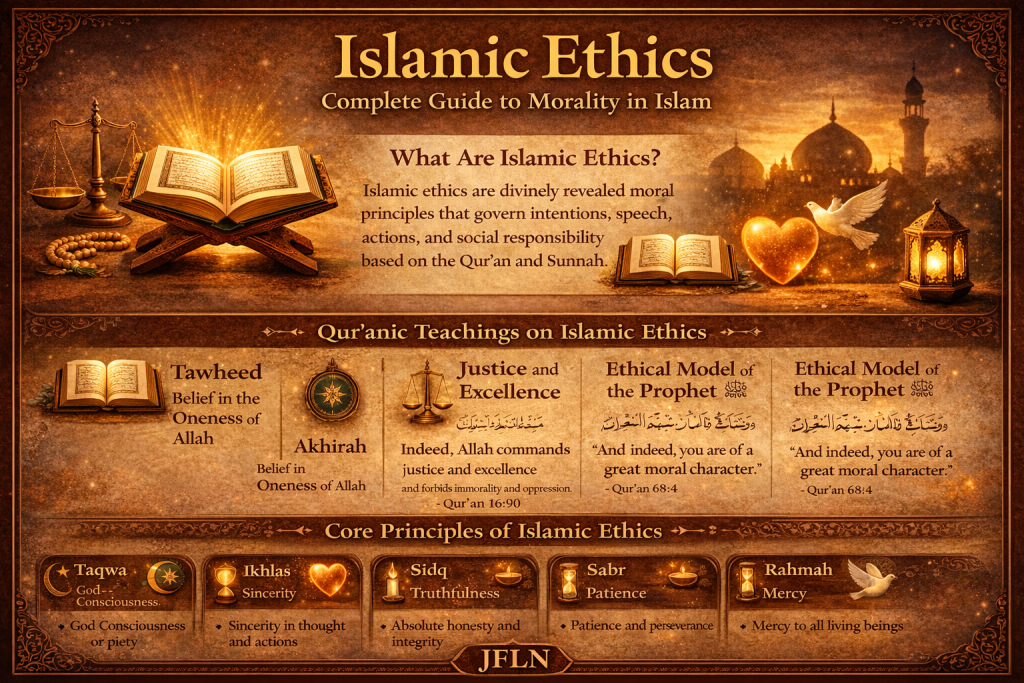
Islamic ethics is a complete moral system revealed by Allah to guide human life in every dimension—belief, character, conduct, and social responsibility. In Islam, ethics are not personal preferences or cultural norms; they are divine commands rooted in the Qur’an and the Sunnah. A person’s ethical behavior reflects the strength of faith (Iman) and determines success in both this world and the Hereafter.
This article presents complete information about Islamic ethics based on the Qur’an, authentic Hadith, and the thoughts of renowned Islamic scholars, explaining how Islamic morality shapes individual character and society.
What Are Islamic Ethics?
Islamic ethics (Akhlaq in Islam) refer to the moral principles ordained by Allah that govern intentions, speech, actions, and relationships. Ethics in Islam are not limited to worship but extend to every aspect of life.
Islamic ethics aim to:
Purify the heart
Establish justice and compassion
Protect human dignity
Create moral balance in society
Unlike man-made ethical systems, Islamic ethics are unchanging, universal, and accountable before Allah.
Foundations of Islamic Ethics
Islamic ethics are built on three fundamental pillars:
1. Tawheed (Oneness of Allah)
Belief in Allah is the root of morality. Ethical behavior flows from recognizing Allah as the ultimate authority.
2. Akhirah (Accountability)
Islam teaches that every action will be judged in the Hereafter, giving ethics a strong sense of responsibility.
3. Revelation (Qur’an & Sunnah)
Moral guidance comes from divine revelation, not human desire or social trends.
Qur’anic Teachings on Islamic Ethics
1. Moral Accountability
Arabic Ayah:
كُلُّ نَفْسٍۢ بِمَا كَسَبَتْ رَهِينَةٌ
Translation:
“Every soul is held accountable for what it earns.”
(Qur’an 74:38)
This verse establishes that every moral choice matters. Islam does not recognize moral neutrality—every deed carries ethical weight.
2. Justice and Moral Excellence
Arabic Ayah:
إِنَّ ٱللَّهَ يَأْمُرُ بِٱلْعَدْلِ وَٱلْإِحْسَـٰنِ وَيَنْهَىٰ عَنِ ٱلْفَحْشَآءِ وَٱلْمُنكَرِ وَٱلْبَغْىِ
Translation:
“Indeed, Allah commands justice and excellence and forbids immorality, wrongdoing, and oppression.”
(Qur’an 16:90)
Scholars describe this verse as a comprehensive summary of Islamic ethics, combining justice (Adl), excellence (Ihsan), and moral restraint.
3. Ethical Model of the Prophet ﷺ
Arabic Ayah:
وَإِنَّكَ لَعَلَىٰ خُلُقٍ عَظِيمٍ
Translation:
“And indeed, you are of a great moral character.”
(Qur’an 68:4)
Allah Himself praised the character of Prophet Muhammad ﷺ, making him the perfect ethical role model for humanity.
Hadith on Islamic Ethics
1. Purpose of Prophethood
Arabic Hadith:
إِنَّمَا بُعِثْتُ لِأُتَمِّمَ مَكَارِمَ الْأَخْلَاقِ
Translation:
“I was sent only to perfect noble character.”
This Hadith proves that ethical reform is central to Islam, not secondary.
2. Ethics and Faith
Arabic Hadith:
أَكْمَلُ الْمُؤْمِنِينَ إِيمَانًا أَحْسَنُهُمْ خُلُقًا
Translation:
“The most complete believers in faith are those with the best character.”
Islam teaches that faith and ethics cannot be separated.
3. Weight of Good Character
Arabic Hadith:
مَا مِنْ شَيْءٍ أَثْقَلُ فِي الْمِيزَانِ مِنْ حُسْنِ الْخُلُقِ
Translation:
“Nothing is heavier on the scale of deeds than good character.”
This Hadith highlights the immense value of ethics in the Hereafter.
Core Principles of Islamic Ethics
1. Taqwa (God-Consciousness)
Taqwa ensures ethical behavior even in private. It is the inner force behind honesty and self-control.
2. Ikhlas (Sincerity)
Actions must be done for Allah alone. Ethics without sincerity lose spiritual value.
3. Sidq (Truthfulness)
Truthfulness is mandatory in speech, business, and promises. Lies and deception are strictly forbidden.
4. Sabr (Patience)
Patience in hardship, obedience, and avoiding sin reflects moral strength.
5. Rahmah (Mercy & Compassion)
Islamic ethics emphasize mercy toward parents, family, neighbors, the poor, animals, and even opponents.
Islamic Ethics According to Scholars
Imam Al-Ghazali (RA)
He described ethics as a permanent inner quality that naturally produces righteous actions. According to him, ethical reform begins with purification of the heart.
Ibn Taymiyyah (RA)
He emphasized that Islamic ethics are inseparable from correct belief and obedience to Allah.
Ibn Qayyim (RA)
He explained that Islamic law revolves around justice, mercy, wisdom, and benefit, which form the foundation of Islamic ethics.
Islamic Ethics in Daily Life
Islamic ethics guide:
Family relationships
Business honesty
Social responsibility
Leadership and governance
Speech, silence, and intentions
A Muslim is ethically accountable at all times, not only during worship.
Why Islamic Ethics Are Timeless
✔ Based on divine revelation
✔ Universal and unchanging
✔ Balance rights and duties
✔ Reform both heart and society
✔ Protect human dignity
Islamic ethics are not influenced by trends—they guide humanity permanently.
