
Moral values in Islam form the heart of Islamic teachings and are essential for building a righteous individual and a just society. Islam does not treat morality as a social choice or cultural habit; rather, it presents moral values as divinely commanded principles rooted in the Qur’an and the Sunnah. In Islam, worship without good character is incomplete, and faith (Iman) is reflected through moral conduct.
This comprehensive guide explains moral values in Islam in detail, based on the Qur’an, authentic Hadith, and the insights of Islamic scholars, showing how Islamic morality shapes personal life and society.
What Are Moral Values in Islam?
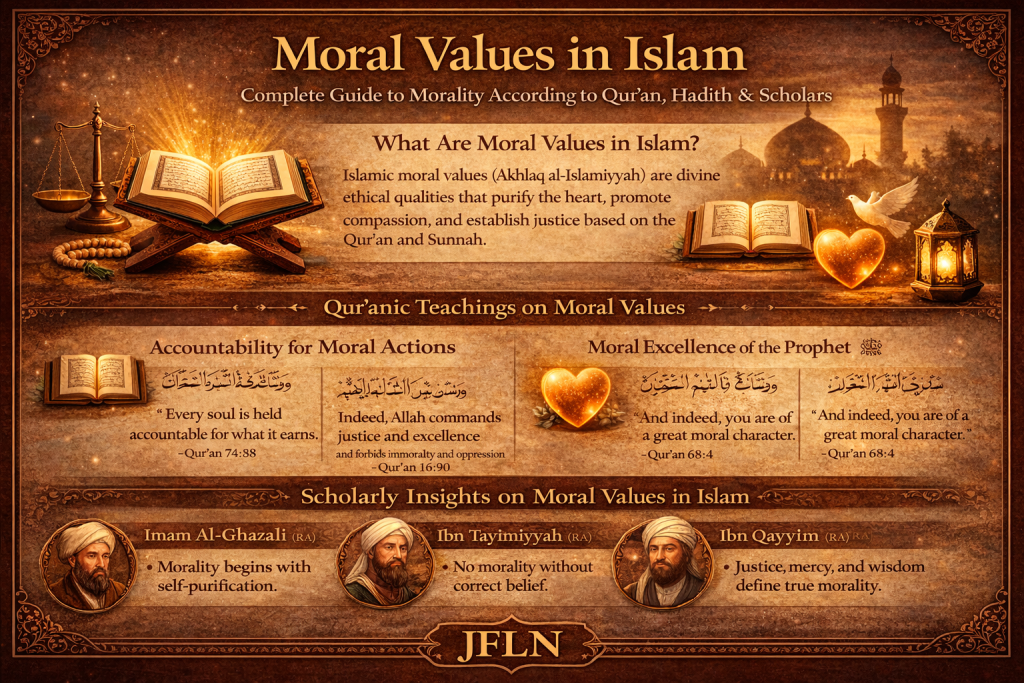
Moral values in Islam (Akhlaq al-Islamiyyah) refer to the ethical qualities and behaviors prescribed by Allah that govern intentions, speech, actions, and relationships. These values aim to purify the heart and promote justice, compassion, honesty, and responsibility.
Islamic moral values:
Are based on divine revelation
Apply to every aspect of life
Are accountable before Allah
Remain constant across time and cultures
Foundation of Moral Values in Islam
Islamic moral values are built upon three fundamental beliefs:
1. Tawheed (Oneness of Allah)
Belief in Allah establishes moral responsibility. A Muslim behaves ethically because Allah is watching and commands goodness.
2. Akhirah (Hereafter)
Islam teaches that every moral action will be rewarded or punished in the Hereafter, giving morality a strong sense of accountability.
3. Revelation (Qur’an & Sunnah)
Right and wrong are defined by Allah, not by human desire or changing social norms.
Qur’anic Teachings on Moral Values in Islam
1. Accountability for Moral Actions
Arabic Ayah:
كُلُّ نَفْسٍۢ بِمَا كَسَبَتْ رَهِينَةٌ
Translation:
“Every soul is held accountable for what it earns.”
(Qur’an 74:38)
This verse establishes that every moral decision matters. Islam teaches personal responsibility for actions, intentions, and behavior.
2. Justice, Goodness, and Moral Balance
Arabic Ayah:
إِنَّ ٱللَّهَ يَأْمُرُ بِٱلْعَدْلِ وَٱلْإِحْسَـٰنِ وَيَنْهَىٰ عَنِ ٱلْفَحْشَآءِ وَٱلْمُنكَرِ وَٱلْبَغْىِ
Translation:
“Indeed, Allah commands justice and excellence and forbids immorality, wrongdoing, and oppression.”
(Qur’an 16:90)
This verse is considered by scholars as a comprehensive summary of Islamic moral values, combining justice (Adl), excellence (Ihsan), and moral restraint.
3. Moral Excellence of the Prophet ﷺ
Arabic Ayah:
وَإِنَّكَ لَعَلَىٰ خُلُقٍ عَظِيمٍ
Translation:
“And indeed, you are of a great moral character.”
(Qur’an 68:4)
Allah praised the moral character of Prophet Muhammad ﷺ, making him the perfect example of Islamic moral values.
Hadith on Moral Values in Islam
1. Purpose of the Prophetic Mission
Arabic Hadith:
إِنَّمَا بُعِثْتُ لِأُتَمِّمَ مَكَارِمَ الْأَخْلَاقِ
Translation:
“I was sent only to perfect noble moral values.”
This Hadith shows that moral refinement is a central objective of Islam.
2. Moral Values and Faith
Arabic Hadith:
أَكْمَلُ الْمُؤْمِنِينَ إِيمَانًا أَحْسَنُهُمْ خُلُقًا
Translation:
“The most complete believers in faith are those with the best moral character.”
Islam teaches that faith is incomplete without strong moral values.
3. Reward of Good Morals
Arabic Hadith:
مَا مِنْ شَيْءٍ أَثْقَلُ فِي الْمِيزَانِ مِنْ حُسْنِ الْخُلُقِ
Translation:
“Nothing is heavier on the scale of deeds than good moral character.”
This Hadith highlights the great reward of moral values in the Hereafter.
Core Moral Values in Islam
1. Taqwa (God-Consciousness)
Taqwa is the foundation of all moral values. It ensures ethical behavior even when no one is watching.
2. Ikhlas (Sincerity)
Moral actions must be done sincerely for Allah, not for praise or recognition.
3. Sidq (Truthfulness)
Truthfulness is essential in speech, business, promises, and testimony. Lies and deception are strictly prohibited.
4. Sabr (Patience)
Patience in hardship, obedience, and avoiding sin reflects moral strength.
5. Rahmah (Mercy & Compassion)
Islamic moral values emphasize kindness toward parents, family, neighbors, the poor, animals, and even enemies.
6. Adl (Justice)
Justice is mandatory in all dealings, regardless of personal feelings or relationships.
Moral Values in Islam According to Scholars
Imam Al-Ghazali (RA)
He described moral values as deep-rooted qualities of the heart that produce righteous actions naturally. According to him, morality begins with self-purification.
Ibn Taymiyyah (RA)
He emphasized that moral values cannot exist without correct belief and obedience to Allah.
Ibn Qayyim (RA)
He stated that the foundation of Islamic teachings is justice, mercy, wisdom, and benefit, which define true moral values.
Moral Values in Islam in Daily Life
Islamic moral values guide:
Family relationships
Business honesty
Social behavior
Leadership and authority
Speech, silence, and intentions
A Muslim is morally accountable at all times, not only during acts of worship.
Why Moral Values in Islam Are Timeless
✔ Based on divine revelation
✔ Universal and unchanging
✔ Balance rights and duties
✔ Reform both individual and society
✔ Protect human dignity
Islamic moral values do not change with trends—they guide humanity permanently.
Related Islamic Articles (Internal Linking – JFLN Style)
👉 Islamic Ethics: Complete Guide According to Qur’an & Sunnah
👉 Islamic Morality and Good Character
👉 Importance of Akhlaq in Islam
👉 How Moral Values Lead to Jannah
Final Reflection
Moral values in Islam form a complete and divine moral system designed to purify the soul and establish justice, mercy, and righteousness. The Qur’an and Sunnah do not merely teach rules; they shape character and transform hearts.
True success in Islam lies in faith, sincerity, and strong moral values.

