
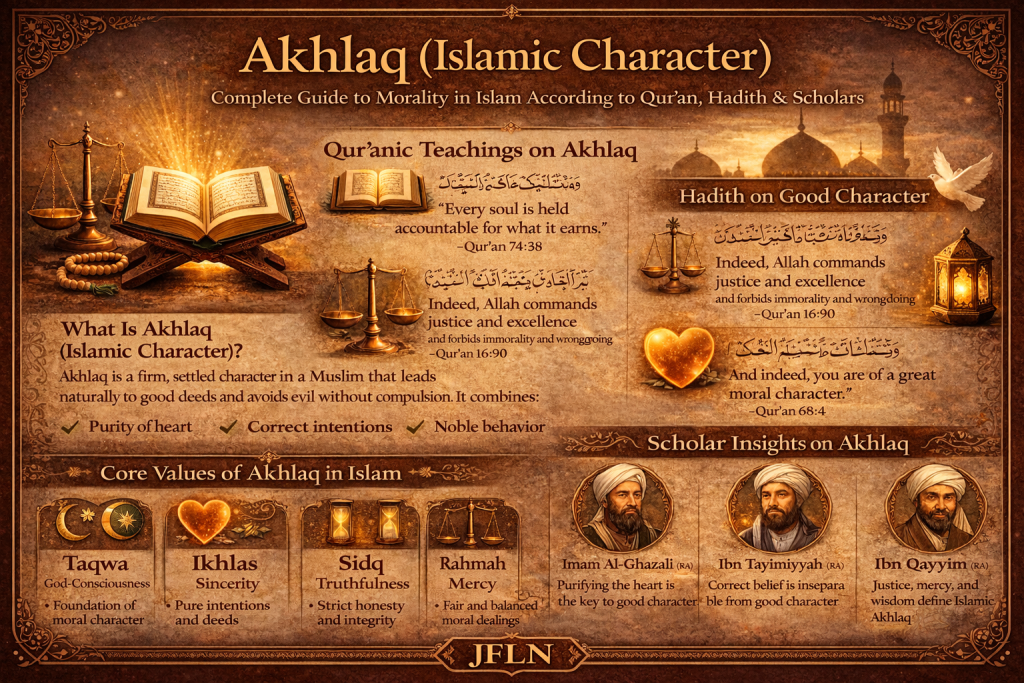
Akhlaq in Islam – Islamic Character Explained with Qur’an & Hadith
Akhlaq (Islamic character) is the soul of Islam and the true reflection of faith (Iman). Islam teaches that worship without good character is incomplete, and a believer’s real value is judged by their morals, behavior, and conduct. Akhlaq in Islam is not limited to good manners; it is a complete moral system that governs intentions, speech, actions, and relationships.
This detailed guide explains Akhlaq (Islamic character) in light of the Qur’an, authentic Hadith, and Islamic scholars’ thought, showing how Islamic morality builds righteous individuals and a just society.
What Is Akhlaq in Islam?
Akhlaq refers to a firm and settled character within a person that naturally leads them to perform good deeds and avoid evil without compulsion. In Islam, Akhlaq combines:
-
Inner purity of the heart
-
Correct intentions
-
Ethical behavior
-
Social responsibility
Islamic Akhlaq is divinely guided, universal, and accountable before Allah.
Foundation of Akhlaq (Islamic Character)
Islamic character is built upon three core beliefs:
1. Tawheed (Oneness of Allah)
A Muslim develops good character because they believe Allah sees everything and commands goodness.
2. Akhirah (Hereafter)
Belief in accountability motivates moral discipline, honesty, and self-control.
3. Qur’an & Sunnah
Akhlaq is not defined by culture or opinion but by divine revelation.
Qur’anic Teachings on Akhlaq
1. Accountability for Character and Actions
Arabic Ayah:
كُلُّ نَفْسٍۢ بِمَا كَسَبَتْ رَهِينَةٌ
Translation:
“Every soul is held accountable for what it earns.”
(Qur’an 74:38)
This verse establishes that character and conduct will be judged by Allah.
2. Command for Justice and Moral Excellence
Arabic Ayah:
إِنَّ ٱللَّهَ يَأْمُرُ بِٱلْعَدْلِ وَٱلْإِحْسَـٰنِ وَيَنْهَىٰ عَنِ ٱلْفَحْشَآءِ وَٱلْمُنكَرِ وَٱلْبَغْىِ
Translation:
“Indeed, Allah commands justice and excellence and forbids immorality, wrongdoing, and oppression.”
(Qur’an 16:90)
This verse summarizes the moral framework of Akhlaq in Islam.
3. The Perfect Example of Akhlaq
Arabic Ayah:
وَإِنَّكَ لَعَلَىٰ خُلُقٍ عَظِيمٍ
Translation:
“And indeed, you are of a great moral character.”
(Qur’an 68:4)
Allah praised the character of Prophet Muhammad ﷺ, making him the ideal model of Islamic Akhlaq.
Hadith on Akhlaq (Islamic Character)
1. Purpose of the Prophetic Mission
Arabic Hadith:
إِنَّمَا بُعِثْتُ لِأُتَمِّمَ مَكَارِمَ الْأَخْلَاقِ
Translation:
“I was sent only to perfect noble character.”
This Hadith proves that perfecting Akhlaq is a core objective of Islam.
2. Akhlaq and Faith
Arabic Hadith:
أَكْمَلُ الْمُؤْمِنِينَ إِيمَانًا أَحْسَنُهُمْ خُلُقًا
Translation:
“The most complete believers in faith are those with the best character.”
Strong faith is always reflected through excellent Akhlaq.
3. Weight of Good Character
Arabic Hadith:
مَا مِنْ شَيْءٍ أَثْقَلُ فِي الْمِيزَانِ مِنْ حُسْنِ الْخُلُقِ
Translation:
“Nothing is heavier on the scale of deeds than good character.”
This Hadith highlights the immense reward of Akhlaq in the Hereafter.
Core Elements of Akhlaq in Islam
1. Taqwa (God-Consciousness)
Taqwa is the foundation of character. It controls desires and ensures ethical behavior even in private.
2. Ikhlas (Sincerity)
Akhlaq must be sincere. Actions done for show lose moral and spiritual value.
3. Sidq (Truthfulness)
Truthfulness in speech, business, and promises is mandatory in Islam.
4. Sabr (Patience)
Patience reflects inner strength and moral maturity.
5. Rahmah (Mercy & Compassion)
Islamic character emphasizes kindness toward parents, family, neighbors, the poor, and even animals.
6. Adl (Justice)
Justice is a non-negotiable element of Islamic Akhlaq.
Akhlaq According to Islamic Scholars
Imam Al-Ghazali (RA)
He defined Akhlaq as deep-rooted qualities of the soul that produce actions naturally. According to him, purification of the heart is the key to good character.
Ibn Taymiyyah (RA)
He emphasized that true Akhlaq cannot exist without correct belief and obedience to Allah.
Ibn Qayyim (RA)
He explained that Islamic teachings revolve around justice, mercy, wisdom, and benefit, which form the essence of Islamic character.
Importance of Akhlaq in Daily Life
Islamic character influences:
-
Family relations
-
Business ethics
-
Social interactions
-
Leadership and authority
-
Speech, silence, and intentions
A Muslim is judged not only by worship but by how they treat others.
Why Akhlaq (Islamic Character) Is Central to Islam
✔ Reflects true faith
✔ Strengthens society
✔ Builds trust and justice
✔ Purifies the soul
✔ Leads to success in the Hereafter
Without Akhlaq, religious practice loses its true spirit.
Related Islamic Articles (Internal Linking – JFLN Style)
-
👉 Islamic Ethics: Complete Guide According to Qur’an & Sunnah
-
👉 Moral Values in Islam Explained
-
👉 Importance of Akhlaq in Islam
-
👉 How Good Character Leads to Jannah
Final Reflection
Akhlaq (Islamic character) is not an optional virtue but the core of Islamic life. The Qur’an and Sunnah aim to transform hearts, refine behavior, and establish justice and mercy through strong moral character.
True success in Islam lies in faith, sincerity, and excellent Akhlaq.
Frequently Asked Questions About Akhlaq (Islamic Character)
What is Akhlaq in Islam?
Akhlaq in Islam refers to Islamic character and moral conduct based on the Qur’an and Sunnah. It includes sincerity, honesty, patience, justice, and compassion in all aspects of life.
Why is Akhlaq important in Islam?
Akhlaq is important because Islam teaches that faith is incomplete without good character. The Prophet Muhammad ﷺ said he was sent to perfect noble character.
What does the Qur’an say about Islamic character?
The Qur’an commands justice, moral excellence, and accountability, and praises the noble character of the Prophet Muhammad ﷺ as the best example for believers.
How are faith and Akhlaq connected?
In Islam, faith and Akhlaq are inseparable. Strong faith produces good character, and good character reflects true belief in Allah.
What are the main qualities of Islamic character?
Key qualities of Islamic character include Taqwa, sincerity, truthfulness, patience, mercy, justice, humility, and responsibility.
