
The goals of Islamic education extend far beyond acquiring academic knowledge or professional skills. Its true purpose is to cultivate righteous, balanced, and conscientious individuals who live with faith, wisdom, and integrity. Islamic education develops the whole person — heart, mind, character, and behavior — in accordance with the guidance of the Qur’an and Sunnah.
Blog Category Islamic
Blog description: The primary goal is to nurture a strong connection with Allah, enabling individuals to recognize their purpose in life and to worship Him sincerely. It seeks to shape believers who are spiritually grounded, morally upright, and socially responsible. Islamic education encourages self-discipline, humility, compassion, and sincerity while building intellectual capability and a sense of responsibility toward society.
Through learning, a Muslim is guided to practice good manners, uphold justice, avoid harmful actions, and contribute positively to the world. Islamic education aims to produce individuals who combine faith with action — believers who use their knowledge to benefit themselves and others, work for the betterment of humanity, and strive for success in both this life and the Hereafter.
Thus, the ultimate goal of Islamic education is to form devoted servants of Allah and responsible caretakers of the earth — people who reflect Islamic values in their thoughts, character, conduct, and contributions to society.
Islamic education is a holistic system that seeks to develop individuals who possess both extensive knowledge and high moral standards, as well as a sense of social responsibility. The foundation of Islamic education is firmly based on the teachings of the Quran and the Hadith, with a strong emphasis on a comprehensive approach that combines intellectual, spiritual, and ethical aspects. The main objectives of Islamic education encompass the enhancement of spirituality, the cultivation of moral and ethical values, the advancement of intellectual capacity, the fostering of social responsibility and unity, the promotion of physical and mental well-being, the preparedness for modern difficulties, and the encouragement of simplicity and humility (Syah & Salsabila, 2023).
One of the primary objectives is to cultivate a robust spiritual bond with Allah, empowering Muslims to live virtuous lives rooted in their faith and conscious of their duties to God and society. This entails instructing individuals on the core rituals of Islam, including prayer (Salah), fasting (Sawm), and the tenets of worship (Rahayu, 2016). Islamic education places significant emphasis on cultivating character and moral integrity, imparting qualities such as honesty, compassion, and altruism, which are crucial for individual growth and community cohesion. By acquiring the ability to discern between ethical and unethical actions, students become equipped to effectively handle ethical quandaries throughout their lifetimes, fostering conscientious individuals who make constructive contributions to their communities (Rahmawati et al., 2022).
The acquisition of knowledge is a basic principle of Islam, and Islamic education aims to provide individuals with both religious and worldly knowledge, empowering them to comprehend and interact with their surroundings (Ashimi, 2017). This encompasses not only the field of religious studies but other disciplines such as physics, mathematics, and literature, cultivating a comprehensive intellectual aptitude. Islamic education fosters the values of Muslim brotherhood and social cohesiveness, motivating pupils to participate in acts of charity (Zakat) and service to others (Jamil et al., 2023). This cultivates harmonious communities where individuals mutually assist one another and collaborate towards shared objectives.
In addition, Islamic education places considerable emphasis on the significance of both physical and mental well-being, promoting a well-rounded lifestyle that encompasses physical fitness, mental fortitude, and spiritual welfare (Hamidi et al., 2010). Adopting this comprehensive approach is crucial for individuals to flourish in all parts of life, fostering a well-balanced and dynamic way of living. Islamic education in the present dynamic era also seeks to provide individuals with the ability to comprehend and actively participate in modern social, political, and economic matters. It imparts knowledge about current events and fosters critical thinking, empowering students to make informed contributions to society. Islamic education seeks to cultivate qualities of modesty and humility, imparting to students the significance of living within their financial capabilities and valuing the benefits they possess (Shah, 2015). Islam promotes a modest way of living, avoiding extravagance and opulence. Islamic education aims to foster these principles as integral to a well-rounded and satisfying existence.
The goals of Islamic education are a comprehensive strategy focused on developing individuals who are capable of personal growth and making meaningful contributions to society. Knowledge acquisition is of utmost importance in Islamic education since it aims to equip students with a strong foundation in both religious and secular knowledge, enabling them to be well-informed and adept at navigating the intricacies of the contemporary world. This educational institution places a significant emphasis on character development, aiming to cultivate moral integrity and ethical conduct in students (Nafis et al., 2022). The goal is to prepare them to become responsible individuals who uphold principles such as honesty, compassion, and justice, thus contributing positively to society. Moreover, social involvement is a crucial aim since Islamic education cultivates a sense of communalism and motivates students to make constructive contributions to society through acts of benevolence and philanthropy, thereby reaffirming the significance of collective welfare. Incorporating spiritual awareness into the educational process is essential, as it seeks to enhance students’ comprehension of faith and spirituality, leading them towards a life of dedication and moral uprightness that is in accordance with Islamic principles (Al Hamdani, 2016). Moreover, it is crucial to adopt a well-rounded development strategy that guarantees the education system fosters intellectual, physical, and emotional growth, thereby enhancing general health and adaptability. Islamic education aims to cultivate civic responsibility by equipping students with the knowledge and skills to comprehend and address current concerns. This education encourages students to actively participate in societal matters and fosters well-informed and engaged citizens who can make meaningful contributions to their communities. These objectives form a complete framework that promotes both personal development and societal cohesion by matching individual desires with communal aims (Attas & Ashraf, 1979). Ultimately, Islamic education aims to cultivate individuals who possess a comprehensive understanding, strong moral character, and a sense of societal accountability. The program seeks to equip Muslims with the necessary tools to live meaningful lives, make valuable contributions to their communities, and uphold the ideals of Islam by integrating spiritual, intellectual, and ethical aspects. This all-encompassing strategy not only advantages the individual but also cultivates a harmonious and prosperous society (Blog, 2024).
The purposes and objectives of Islamic education are diverse, with a focus on directing Muslims towards a virtuous way of life based on the teachings of the Quran and Prophet Muhammad (peace be upon him). The primary objective is to provide a strong basis for adhering to Islamic values, instructing individuals on the methods of prayer, fasting, eating, sleeping, and conducting other aspects of life in accordance with Islamic teachings (Badawi, 1979). One of the main objectives is to establish equilibrium, as Islam promotes involvement in the physical realm while giving precedence to the spiritual aspect. The education system assists pupils in managing their social and religious obligations (Rahayu, 2016). Another essential goal is to cultivate a robust sense of Muslim fraternity and affiliation with the community. Studying the courageous acts and principles of past generations instills in students a deep admiration for Islam and a readiness to make personal sacrifices in the name of their faith (Rahayu, 2016).
The objective of Islamic education is to cultivate persons who possess a comprehensive understanding of various facets of life, including social, political, and economic matters. The objective is to cultivate responsible individuals who possess a comprehensive understanding of their entitlements, exhibit reverence for legal regulations, and demonstrate robust emotional and mental fortitude (Badawi, 1979). Muslim academics throughout history have demonstrated their drive to investigate the physical universe and make valuable contributions to scientific advancement (Ahmed et al., 2005). Moreover, Islamic education aims to foster beneficial transformations in society by discarding antiquated beliefs and adapting to changing conditions, given that Islam is a progressive faith. Additionally, it promotes a modest way of living and temperance, avoiding both excessive worldly pleasures and total renunciation (Suradi et al., 2021). Islamic education strives to cultivate a cohort of ethically upright, well-informed, and well-rounded persons who possess a strong foundation in their religious beliefs and actively participate in and make valuable contributions to the global community. The aims of the program cover the development of one’s spirituality, intelligence, social skills, and personal growth (Blog, 2024).
Featured Image
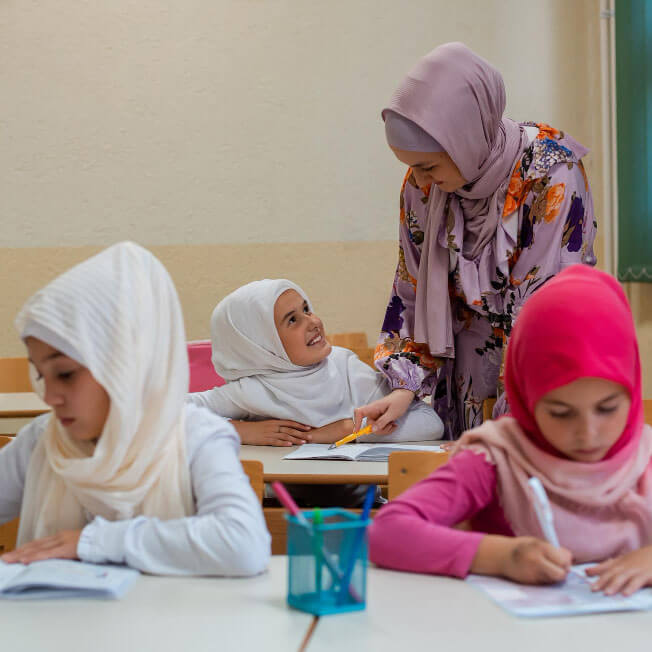
Please include a short bio The goals of Islamic education extend far beyond acquiring academic knowledge or technical skills. Its purpose is to nurture individuals who possess a deep connection with Allah, strong moral character, and a sense of responsibility toward themselves and society. Islamic education focuses on developing the entire human being — mind, heart, soul, and behavior — guided by the principles of the Qur’an and Sunnah.
The core goal is to cultivate Iman (faith) and Taqwa (God-consciousness), enabling a believer to recognize their purpose in life and strive to fulfill it with sincerity. It aims to shape individuals who are spiritually grounded, intellectually capable, emotionally balanced, and socially committed. Through learning, believers are inspired to act with honesty, justice, humility, and compassion, becoming positive contributors to their families and communities.
Islamic education prepares individuals to apply knowledge in their daily lives, uphold ethical values, avoid harmful behaviors, and serve humanity with excellence. Ultimately, its goal is to raise righteous individuals who seek success in both worlds — dunya and akhirah — by living a life based on faith, wisdom, and good deeds.
Short Bio
Mushtabi Fatma is a dedicated Islamic writer passionate about sharing beneficial knowledge and spiritual insights. Her work focuses on faith, character development, and inspiring Muslims to live with purpose and closeness to Allah.
Notes (if any)
- Islamic education emphasizes both spiritual and intellectual development — not just academic learning.
- True education in Islam must lead to good character (akhlaq) and righteous actions.
- The ultimate goal is success in this world and the Hereafter, not merely worldly achievements.
- Knowledge must be accompanied by iman (faith), taqwa (God-consciousness), and ihsan (excellence).
- Education starts at home and continues throughout life — from cradle to grave.
- Teachers and parents play a significant role in shaping moral and spiritual growth.
- Both religious and worldly sciences are valued when used to benefit humanity and draw closer to Allah.
- Knowledge that does not lead to humility and good deeds is not considered true Islamic knowledge.
About The Author


