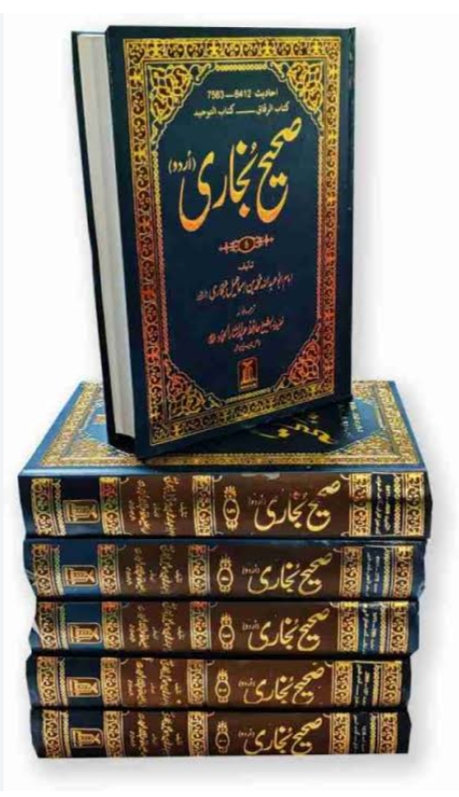
Sahih Bukhari Volume 2, Book 15, Hadith Number 69
Narated By ‘Abdullah bin Umar: Umar bought a silk cloak from the market, took it to Allah’s
Apostle and said, “O Allah’s Apostle! Take it and adorn yourself with it during the ‘Id and when
the delegations visit you.” Allah’s Apostle (p.b.u.h) replied, “This dress is for those who have no
share (in the Hereafter).” After a long period Allah’s Apostle (p.b.u.h) sent to Umar a cloak of silk
brocade. Umar came to Allah’s Apostle (p.b.u.h) with the cloak and said, “O Allah’s Apostle! You
said that this dress was for those who had no share (in the Hereafter); yet you have sent me this
cloak.” Allah’s Apostle said to him, “Sell it and fulfill your needs by it.”
SAHIH BUKHARI BOOK 15. THE TWO FESTIVALS (EIDS).
Sahih Bukhari Volume 2, Book 15, Hadith Number 70
Narated By ‘Aisha: Allah’s Apostle (p.b.u.h) came to my house while two girls were singing
beside me the songs of Buath (a story about the war between the two tribes of the Ansar, the
Khazraj and the Aus, before Islam). The Prophet (p.b.u.h) lay down and turned his face to the
other side. Then Abu Bakr came and spoke to me harshly saying, “Musical instruments of Satan
near the Prophet (p.b.u.h) ?” Allah’s Apostle (p.b.u.h) turned his face towards him and said,
“Leave them.” When Abu Bakr became inattentive, I signalled to those girls to go out and they
left. It was the day of ‘Id, and the Black people were playing with shields and spears; so either I
requested the Prophet (p.b.u.h) or he asked me whether I would like to see the display. I replied
in the affirmative. Then the Prophet (p.b.u.h) made me stand behind him and my cheek was
touching his cheek and he was saying, “Carry on! O Bani Arfida,” till I got tired. The Prophet
(p.b.u.h) asked me, “Are you satisfied (Is that sufficient for you)?” I replied in the affirmative and
he told me to leave.
SAHIH BUKHARI BOOK 15. THE TWO FESTIVALS (EIDS).
Sahih Bukhari Volume 2, Book 15, Hadith Number 71
Narated By Al-Bara’: I heard the Prophet (p.b.u.h) delivering a Khutba saying, “The first thing
to be done on this day (first day of ‘Id ul Adha) is to pray; and after returning from the prayer we
slaughter our sacrifices (in the name of Allah) and whoever does so, he acted according to our
Sunna (traditions).”
SAHIH BUKHARI BOOK 15. THE TWO FESTIVALS (EIDS).
Sahih Bukhari Volume 2, Book 15, Hadith Number 72
Narated By ‘Aisha: Abu Bakr came to my house while two small Ansari girls were singing
beside me the stories of the Ansar concerning the Day of Buath. And they were not singers. Abu
Bakr said protestingly, “Musical instruments of Satan in the house of Allah’s Apostle!” Ithappened on the ‘Id day and Allah’s Apostle said, “O Abu Bakr! There is an ‘Id for every nation
and this is our ‘Id.”
SAHIH BUKHARI BOOK 15. THE TWO FESTIVALS (EIDS).
Sahih Bukhari Volume 2, Book 15, Hadith Number 73
Narated By Anas bin Malik: Allah’s Apostle never proceeded (for the prayer) on the Day of ‘Id-
ul-Fitr unless he had eaten some dates. Anas also narrated: The Prophet used to eat odd
number of dates.
SAHIH BUKHARI BOOK 15. THE TWO FESTIVALS (EIDS).
Sahih Bukhari Volume 2, Book 15, Hadith Number 74
Narated By Anas: The Prophet said, “Whoever slaughtered (his sacrifice) before the ‘Id prayer,
should slaughter again.” A man stood up and said, “This is the day on which one has desire for
meat,” and he mentioned something about his neighbors. It seemed that the Prophet I believed
him. Then the same man added, “I have a young she-goat which is dearer to me than the meat
of two sheep.” The Prophet permitted him to slaughter it as a sacrifice. I do not know whether
that permission was valid only for him or for others as well.
SAHIH BUKHARI BOOK 15. THE TWO FESTIVALS (EIDS).
Sahih Bukhari Volume 2, Book 15, Hadith Number 75
Narated By Al-Bara’ bin ‘Azib: The Prophet delivered the Khutba after offering the prayer on
the Day of Nahr and said, “Whoever offers the prayer like us and slaughters like us then his
Nusuk (sacrifice) will be accepted by Allah. And whoever slaughters his sacrifice before the ‘Id
prayer then he has not done the sacrifice.” Abi Burda bin Niyar, the uncle of Al-Bara’ said, “O
Allah’s Apostle! I have slaughtered my sheep before the ‘Id prayer and I thought today as a day
of eating and drinking (not alcoholic drinks), and I liked that my sheep should be the first to be
slaughtered in my house. So slaughtered my sheep and took my food before coming for the
prayer.” The Prophet said, “The sheep which you have slaughtered is just mutton (not a
Nusuk).” He (Abu Burda) said, “O Allah’s Apostle! I have a young she-goat which is dearer to
me than two sheep. Will that be sufficient as a Nusuk on my behalf? “The Prophet (p.b.u.h) said,
“Yes, it will be sufficient for you but it will not be sufficient (as a Nusuk) for anyone else after
you.”
SAHIH BUKHARI BOOK 15. THE TWO FESTIVALS (EIDS).
Sahih Bukhari Volume 2, Book 15, Hadith Number 76
Narated By Abu Sa’id Al-Khudri: The Prophet used to proceed to the Musalla on the days of
Id-ul-Fitr and Id-ul-Adha; the first thing to begin with was the prayer and after that he would
stand in front of the people and the people would keep sitting in their rows. Then he would
preach to them, advise them and give them orders, (i.e. Khutba). And after that if he wished to
send an army for an expedition, he would do so; or if he wanted to give and order, he would do
so, and then depart. The people followed this tradition till I went out with Marwan, the Governor
of Medina, for the prayer of Id-ul-Adha or Id-ul-Fitr.When we reached the Musalla, there was a pulpit made by Kathir bin As-Salt. Marwan
wanted to get up on that pulpit before the prayer. I got hold of his clothes but he pulled
them and ascended the pulpit and delivered the Khutba before the prayer. I said to him,
“By Allah, you have changed (the Prophet’s tradition).” He replied, “O Abu Sa’id! Gone
is that which you know.” I said, “By Allah! What I know is better than what I do not
know.” Marwan said, “People do not sit to listen to our Khutba after the prayer, so I
delivered the Khutba before the prayer.”
SAHIH BUKHARI BOOK 15. THE TWO FESTIVALS (EIDS).
Sahih Bukhari Volume 2, Book 15, Hadith Number 77
Narated By ‘Abdullah bin Umar: Allah’s Apostle used to offer the prayer of ‘Id-ul-Adha and ‘Id-
ul-Fitr and then deliver the Khutba after the prayer.
SAHIH BUKHARI BOOK 15. THE TWO FESTIVALS (EIDS).
Sahih Bukhari Volume 2, Book 15, Hadith Number 78
Narated By Ibn Juraij: ‘Ata’ said, “Jabir bin ‘Abdullah said, ‘The Prophet went out on the Day of
‘Id-ul-Fitr and offered the prayer before delivering the Khutba, Ata told me that during the early
days of IbnAz-Zubair, Ibn Abbas had sent a message to him telling him that the Adhan for the
‘Id Prayer was never pronounced (in the life time of Allah’s Apostle) and the Khutba used to be
delivered after the prayer. Ata told me that Ibn Abbas and Jabir bin ‘Abdullah, had said, ú-
where was no Adhan for the prayer of ‘7d-ul-Fitr and ‘Id-ul-Aqha.” ‘At a’ said, “I heard Jabir bin
‘Abdullah saying, ‘The Prophet stood up and started with the prayer, and after it he delivered the
Khutba. When the Prophet of Allah (p.b.u.h) finished (the Khutba), he went to the women and
preached to them, while he was leaning on Bilal’s hand. Bilal was spreading his garment and
the ladies were putting alms in it.’ ” I said to Ata, “Do you think it incumbent upon an Imam to go
to the women and preach to them after finishing the prayer and Khutba?” ‘Ata’ said, “No doubt it
is incumbent on Imams to do so, and why should they not do so?”
SAHIH BUKHARI BOOK 15. THE TWO FESTIVALS (EIDS).
Sahih Bukhari Volume 2, Book 15, Hadith Number 79
Narated By Ibn Abbas: I offered the ‘Id prayer with Allah’s Apostle, Abu Bakr, Umar and
‘Uthman and all of them offered the prayer before delivering the Khutba.
SAHIH BUKHARI BOOK 15. THE TWO FESTIVALS (EIDS).
Sahih Bukhari Volume 2, Book 15, Hadith Number 80
Narated By Ibn Umar: Allah’s Apostle, Abu Bakr and Umar! used to offer the two ‘Id prayers
before delivering the KhutbaSahih Bukhari Volume 2, Book 15, Hadith Number 81
Narated By Ibn Abbas: The Prophet offered a two Rakat prayer on the Day of Id ul Fitr and he
did not pray before or after it. Then he went towards women along with Bilal and ordered them
to pay alms and so they started giving their earrings and necklaces (in charity).
SAHIH BUKHARI BOOK 15. THE TWO FESTIVALS (EIDS).
Sahih Bukhari Volume 2, Book 15, Hadith Number 82
Narated By Al-Bara’ bin ‘Azib: The Prophet (p.b.u.h) said, “The first thing that we should do on
this day of ours is to pray and then return to slaughter the sacrifice. So anyone who does so, he
acted according to our Sunna (tradition), and whoever slaughtered the sacrifice before the
prayer, it was just meat which he presented to his family and would not be considered as
Nusuk.” A person from the Ansar named Abu Burda bin Niyyar said, “O Allah’s Apostle! I
slaughtered the Nusuk (before the prayer) but I have a young she-goat which is better than an
older sheep.” The Prophet I said, “Sacrifice it in lieu of the first, but it will be not sufficient (as a
sacrifice) for anybody else after you.”
SAHIH BUKHARI BOOK 15. THE TWO FESTIVALS (EIDS).
Sahih Bukhari Volume 2, Book 15, Hadith Number 83
Narated By Said bin Jubair: I was with Ibn Umar when a spear head pierced the sole of his
foot and his foot stuck to the paddle of the saddle and I got down and pulled his foot out, and
that happened in Mina. Al-Hajjaj got the news and came to enquire about his health and said,
“Alas! If we could only know the man who wounded you!” Ibn Umar said, “You are the one who
wounded me.” Al-Hajjaj said, “How is that?” Ibn Umar said, “You have allowed the arms to be
carried on a day on which nobody used to carry them and you allowed arms to be carried in the
Haram even though it was not allowed before.”
SAHIH BUKHARI BOOK 15. THE TWO FESTIVALS (EIDS).
Sahih Bukhari Volume 2, Book 15, Hadith Number 84
Narated By Said bin ‘Amr bin Said bin Al-‘Aas: Al-Hajjaj went to Ibn Umar while I was
present there. Al-Hajjaj asked Ibn Umar, “How are you?” Ibn Umar replied, “I am all right,” Al-
Hajjaj asked, “Who wounded you?” Ibn Umar replied, “The person who allowed arms to be
carried on the day on which it was forbidden to carry them (he meant Al-Hajjaj)”
SAHIH BUKHARI BOOK 15. THE TWO FESTIVALS (EIDS).
Sahih Bukhari Volume 2, Book 15, Hadith Number 85
Narated By Al-Bara’: The Prophet delivered the Khutba on the day of Nahr (‘Id-ul-Adha) and
said, “The first thing we should do on this day of ours is to pray and then return and slaughter
(our sacrifices). So anyone who does so he acted according to our Sunna; and whoever
slaughtered before the prayer then it was just meat that he offered to his family and would notbe considered as a sacrifice in any way. My uncle Abu Burda bin Niyyar got up and said, “O,
Allah’s Apostle! I slaughtered the sacrifice before the prayer but I have a young she-goat which
is better than an older sheep.” The Prophet said, “Slaughter it in lieu of the first and such a goat
will not be considered as a sacrifice for anybody else after you.”
SAHIH BUKHARI BOOK 15. THE TWO FESTIVALS (EIDS).
Sahih Bukhari Volume 2, Book 15, Hadith Number 86
Narated By Ibn Abbas: The Prophet said, “No good deeds done on other days are superior to
those done on these (first ten days of Dhul Hijja).” Then some companions of the Prophet said,
“Not even Jihad?” He replied, “Not even Jihad, except that of a man who does it by putting
himself and his property in danger (for Allah’s sake) and does not return with any of those
things.”
SAHIH BUKHARI BOOK 15. THE TWO FESTIVALS (EIDS).
Sahih Bukhari Volume 2, Book 15, Hadith Number 87
Narated By Muhammad bin Abi Bakr Al-Thaqafi: While we were going from Mina to ‘Arafat, I
asked Anas bin Malik, about Talbiya, “How did you use to say Talbiya in the company of the
Prophet?” Anas said: “People used to say Talbiya and their saying was not objected to and they
used to say Takbir and that was not objected to either.”
SAHIH BUKHARI BOOK 15. THE TWO FESTIVALS (EIDS).
Sahih Bukhari Volume 2, Book 15, Hadith Number 88
Narated By Um ‘Atiya: We used to be ordered to come out on the Day of ‘Id and even bring
out the virgin girls from their houses and menstruating women so that they might stand behind
the men and say Takbir along with them and invoke Allah along with them and hope for the
blessings of that day and for purification from sins.
SAHIH BUKHARI BOOK 15. THE TWO FESTIVALS (EIDS).
Sahih Bukhari Volume 2, Book 15, Hadith Number 89
Narated By Ibn Umar: On the day of ‘Id-ul-Fitr and ‘Id-ul-Adha a spear used to be planted in
front of the Prophet I (as a Sutra for the prayer) and then he would pray.
SAHIH BUKHARI BOOK 15. THE TWO FESTIVALS (EIDS).
Sahih Bukhari Volume 2, Book 15, Hadith Number 90
Narated By Ibn Umar: The Prophet used to proceed to the Musalla and an ‘Anaza used to be
carried before him and planted in the Musalla in front of him and he would pray facing it (as a
Sutra).Sahih Bukhari Volume 2, Book 15, Hadith Number 91
Narated By Muhammad: Um ‘Atiyya said: “Our Prophet ordered us to come out (on ‘Id day)
with the mature girls and the virgins staying in seclusion.” Hafsa narrated the above mentioned
Hadith and added, “The mature girls or virgins staying in seclusion but the menstruating women
had to keep away from the Musalla.”
SAHIH BUKHARI BOOK 15. THE TWO FESTIVALS (EIDS).
Sahih Bukhari Volume 2, Book 15, Hadith Number 92
Narated By Ibn Abbas: I (in my boyhood) went out with the Prophet on the day of ‘Id ul Fitr or
Id-ul-Adha. The Prophet prayed and then delivered the Khutba and then went towards the
women, preached and advised them and ordered them to give alms.
SAHIH BUKHARI BOOK 15. THE TWO FESTIVALS (EIDS).
Sahih Bukhari Volume 2, Book 15, Hadith Number 93
Narated By Al-Bara’: The Prophet went towards Al-Baqi (the grave-yard at Medina) on the day
of Id-ul-Adha and offered a two-Rakat prayer (of ‘Id-ul-Adha) and then faced us and said, “On
this day of ours, our first act of worship is the offering of prayer and then we will return and
slaughter the sacrifice, and whoever does this concords with our Sunna; and whoever
slaughtered his sacrifice before that (i.e. before the prayer) then that was a thing which he
prepared earlier for his family and it would not be considered as a Nusuk (sacrifice.)” A man
stood up and said, “O, Allah’s Apostle! I slaughtered (the animal before the prayer) but I have a
young she-goat which is better than an older sheep.” The Prophet (p.b.u.h) said to him,
“Slaughter it. But a similar sacrifice will not be sufficient for anybody else after you.”
SAHIH BUKHARI BOOK 15. THE TWO FESTIVALS (EIDS).
Sahih Bukhari Volume 2, Book 15, Hadith Number 94
Narated By ‘Abdur Rahman bin ‘Abis: Ibn Abbas was asked whether he had joined the
Prophet in the ‘Id prayer. He said, “Yes. And I could not have joined him had I not been young.
(The Prophet came out) till he reached the mark which was near the house of Kathir bin As-Salt,
offered the prayer, delivered the Khutba and then went towards the women. Bilal was
accompanying him. He preached to them and advised them and ordered them to give alms. I
saw the women putting their ornaments with their outstretched hands into Bilal’s garment. Then
the Prophet along with Bilal returned home.
SAHIH BUKHARI BOOK 15. THE TWO FESTIVALS (EIDS).
Sahih Bukhari Volume 2, Book 15, Hadith Number 95
Narated By Ibn Juraij: ‘Ata’ told me that he had heard Jabir bin ‘Abdullah saying, “The Prophet
stood up to offer the prayer of the ‘Id ul Fitr. He first offered the prayer and then delivered the
Khutba. After finishing it he got down (from the pulpit) and went towards the women and advisedthem while he was leaning on Bilal’s hand. Bilal was spreading out his garment where the
women were putting their alms.” I asked ‘Ata’ whether it was the Zakat of ‘Id ul Fitr. He said,
“No, it was just alms given at that time. Some lady put her finger ring and the others would do
the same.” I said, (to ‘Ata’), “Do you think that it is incumbent upon the Imam to give advice to
the women (on ‘Id day)?” He said, “No doubt, it is incumbent upon the Imams to do so and why
should they not do so?” Al-Hasan bin Muslim told me that Ibn Abbas had said, “I join the
Prophet, Abu Bakr, Umar and ‘Uthman in the ‘Id ul Fitr prayers. They used to offer the prayer
before the Khutba and then they used to deliver the Khutba afterwards. Once the Prophet I
came out (for the ‘Id prayer) as if I were just observing him waving to the people to sit down. He,
then accompanied by Bilal, came crossing the rows till he reached the women. He recited the
following verse: ‘O Prophet! When the believing women come to you to take the oath of fealty to
you… (to the end of the verse) (60.12).’ After finishing the recitation he said, “O ladies! Are you
fulfilling your covenant?” None except one woman said, “Yes.” Hasan did not know who was
that woman. The Prophet said, “Then give alms.” Bilal spread his garment and said, “Keep on
giving alms. Let my father and mother sacrifice their lives for you (ladies).” So the ladies kept on
putting their Fatkhs (big rings) and other kinds of rings in Bilal’s garment.” Abdur-Razaq said, ”
‘Fatkhs’ is a big ring which used to be worn in the (Pre-lslamic) period of ignorance.
SAHIH BUKHARI BOOK 15. THE TWO FESTIVALS (EIDS).
Sahih Bukhari Volume 2, Book 15, Hadith Number 96
Narated By Aiyub: Hafsa bint Sirin said, “On Id we used to forbid our girls to go out for ‘Id
prayer. A lady came and stayed at the palace of Bani Khalaf and I went to her. She said, ‘The
husband of my sister took part in twelve holy battles along with the Prophet and my sister was
with her husband in six of them. My sister said that they used to nurse the sick and treat the
wounded. Once she asked, ‘O Allah’s Apostle! If a woman has no veil, is there any harm if she
does not come out (on ‘Id day)?’ The Prophet said, ‘Her companion should let her share her veil
with her, and the women should participate in the good deeds and in the religious gatherings of
the believers.’ ” Hafsa added, “When Um-‘Atiya came, I went to her and asked her, ‘Did you
hear anything about so-and-so?’ Um-‘Atlya said, ‘Yes, let my father be sacrificed for the Prophet
(p.b.u.h). (And whenever she mentioned the name of the Prophet she always used to say, ‘Let
my father be’ sacrificed for him). He said, ‘Virgin mature girls staying often screened (or said,
‘Mature girls and virgins staying often screened… Aiyub is not sure as which was right) and
menstruating women should come out (on the ‘Id day). But the menstruating women should
keep away from the Musalla. And all the women should participate in the good deeds and in the
religious gatherings of the believers’.” Hafsa said, “On that I said to Um-‘Atiya, ‘Also those who
are menstruating?’ ” Um-‘Atiya replied, “Yes. Do they not present themselves at ‘Arafat and
elsewhere?”.
SAHIH BUKHARI BOOK 15. THE TWO FESTIVALS (EIDS).
Sahih Bukhari Volume 2, Book 15, Hadith Number 97
Narated By Um-‘Atiya: We were ordered to go out (for ‘Id) and also to take along with us the
menstruating women, mature girls and virgins staying in seclusion. (Ibn ‘Aun said, “Or mature
virgins staying in seclusion).” The menstruating women could present themselves at the
religious gathering and invocation of Muslims but should keep away from their Musalla.Sahih Bukhari Volume 2, Book 15, Hadith Number 98
Narated By Ibn ‘Umar: The Prophet (p.b.u.h) used to Nahr or slaughter sacrifices at the
Musalla (on ‘Id-ul-Adha).
SAHIH BUKHARI BOOK 15. THE TWO FESTIVALS (EIDS).
Sahih Bukhari Volume 2, Book 15, Hadith Number 99
Narated By Al-Bara’ bin ‘Azib: On the day of Nahr Allah’s Apostle delivered the Khutba after
the ‘Id prayer and said, “Anyone who prayed like us and slaughtered the sacrifice like we did
then he acted according to our (Nusuk) tradition of sacrificing, and whoever slaughtered the
sacrifice before the prayer, then that was just mutton (i.e. not sacrifice).” Abu Burda bin Naiyar
stood up and said, “O Allah’s Apostle! By Allah, I slaughtered my sacrifice before I offered the
(Id) prayer and thought that today was the day of eating and drinking (non-alcoholic drinks) and
so I made haste (in slaughtering) and ate and also fed my family and neighbors.” Allah’s Apostle
said, “That was just mutton (not a sacrifice).” Then Abu Burda said, “I have a young she-goat
and no doubt, it is better than two sheep. Will that be sufficient as a sacrifice for me?” The
Prophet replied, “Yes. But it will not be sufficient for anyone else (as a sacrifice), after you.”
SAHIH BUKHARI BOOK 15. THE TWO FESTIVALS (EIDS).
Sahih Bukhari Volume 2, Book 15, Hadith Number 100
Narated By Anas bin Malik: Allah’s Apostle offered the prayer on the day of Nahr and then
delivered the Khutba and ordered that whoever had slaughtered his sacrifice before the prayer
should repeat it, that is, should slaughter another sacrifice. Then a person from the Ansar stood
up and said, “O Allah’s Apostle! because of my neighbors (he described them as being very
needy or poor) I slaughtered before the prayer. I have a young she-goat which, in my opinion, is
better than two sheep.” The Prophet gave him the permission for slaughtering it as a sacrifice.
SAHIH BUKHARI BOOK 15. THE TWO FESTIVALS (EIDS).
Sahih Bukhari Volume 2, Book 15, Hadith Number 101
Narated By Jundab: On the day of Nahr the Prophet offered the prayer and delivered the
Khutba and then slaughtered the sacrifice and said, “Anybody who slaughtered (his sacrifice)
before the prayer should slaughter another animal in lieu of it, and the one who has not yet
slaughtered should slaughter the sacrifice mentioning Allah’s name on it.”
SAHIH BUKHARI BOOK 15. THE TWO FESTIVALS (EIDS).
Sahih Bukhari Volume 2, Book 15, Hadith Number 102
Narated By Jabir bin ‘Abdullah: On the Day of ‘Id the Prophet used to return (after offering the
‘Id prayer) through a way different from that by which he went.Sahih Bukhari Volume 2, Book 15, Hadith Number 103
Narated By ‘Urwa: On the authority of ‘Aisha. On the days of Mina, (11th, 12th, and 13th of
Dhul-Hijjah) Abu Bakr came to her while two young girls were beating the tambourine and the
Prophet was lying covered with his clothes. Abu Bakr scolded them and the Prophet uncovered
his face and said to Abu Bakr, “Leave them, for these days are the days of ‘Id and the days of
Mina.” ‘Aisha further said, “Once the Prophet was screening me and I was watching the display
of black slaves in the Mosque and (‘Umar) scolded them. The Prophet said, ‘Leave them. O
Bani Arfida! (carry on), you are safe (protected)’.”
SAHIH BUKHARI BOOK 15. THE TWO FESTIVALS (EIDS).
Sahih Bukhari Volume 2, Book 15, Hadith Number 104
Narated By Ibn ‘Abbas: The Prophet went out and offered a two Rakat prayer on the Day of ‘Id
ul Fitr and did not offer any other prayer before or after it and at that time Bilal was
accompanying him.
About The Author